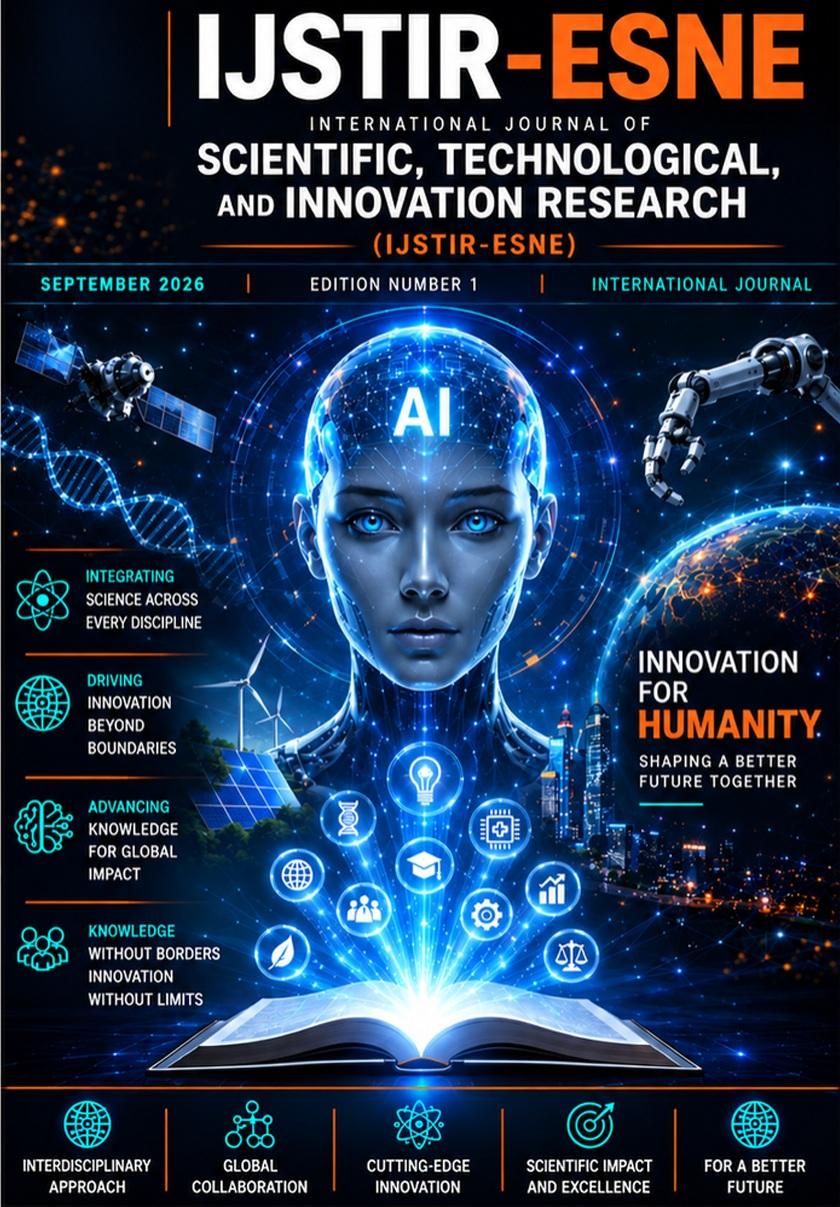
跨學科科學,造福人類的創新。第01卷/2026年9月
創刊號2026年9月

International Journal of Scientific, Technological, and Innovation Research (IJSTIR-ESNE)

Emerging Science, New Technologies & Engineering(ESNE)

科學
無界。
有使命的創新。

連接跨學科思想,推動塑造美好未來的知識。

多學科研究 獨立評審框架
01
第1卷/第1期2026年9月
教育科學新技術工程瞭解期刊範圍 ↗
研究焦點

推動世界前進的思想。

查看本期內容
IJSTIR-ESNE · September 2026 · 01

知識社會中的人工智慧:邁向永續未來的數位轉型、技術創新與倫理挑戰

Author
Antonio Baez Ávila, M.S.
Institution
Instituto Politécnico Nacional.
Academic unit
ESIME-Zacatenco.
Read abstract

Abstract

Artificial intelligence (AI) is one of the most significant technologies driving the development of the knowledge society, owing to its ability to transform organizational processes, foster technological innovation, and improve decision-making. Its integration into strategic sectors such as education, healthcare, industry, and services has created new opportunities to automate activities, analyze large volumes of information, and develop intelligent solutions. However, its implementation also raises ethical challenges concerning data privacy, algorithmic bias, transparency, and technological accountability.

The objective of this research is to analyze the influence of artificial intelligence on digital transformation and technological innovation, considering its main applications, benefits, and ethical challenges. A descriptive and exploratory approach is adopted, based on a literature review and a comparative analysis of technological indicators across four strategic sectors.

The study identifies opportunities to strengthen organizational efficiency, service personalization, and the development of innovative technological solutions. Furthermore, it emphasizes the importance of establishing governance mechanisms, human oversight, and safeguards for fundamental rights. It is concluded that artificial intelligence should be implemented through strategies that integrate innovation, ethical responsibility, digital inclusion, and sustainability.

Published article · September 2026
IJSTIR-ESNE · September 2026 · 02

智慧高等教育:在科技類高等教育機構實施預測分析模型,以早期辨識學生輟學風險

Author
Rodrigo Alfredo Gris Suarez, PhD.
Institution
Escuela Superior “Nueva Era”.
Academic unit
Escuela Superior “Nueva Era”.
Read abstract

Abstract

Student dropout represents one of the major challenges for higher education institutions specializing in technology. The objective of this research was to design and evaluate a predictive analytics model capable of timely identification of students at risk of dropping out, using academic variables recorded on institutional platforms. A quantitative, correlational study was conducted using a simulated dataset of 185 students.

Decision Tree, Random Forest, and Logistic Regression algorithms were compared to estimate dropout risk. The simulated results showed that Random Forest achieved the best predictive performance, with an accuracy of 93.4%, enabling the early identification of students with a higher probability of dropping out. It is concluded that incorporating predictive models into university digital ecosystems can strengthen institutional decision-making and support preventive academic support strategies.

Published article · September 2026
IJSTIR-ESNE · September 2026 · 03

新一代數位醫療:以人工智慧與資料科學為基礎的糖尿病風險早期評估智慧網路平台

Author
Rodrigo Alfredo Gris Suarez, PhD.
Institution
Escuela Superior “Nueva Era”.
Academic unit
Escuela Superior “Nueva Era”.
Read abstract

Abstract

Diabetes mellitus is a priority public health issue due to its rising prevalence and the complications associated with sustained hyperglycemia. Early detection enables the implementation of preventive interventions and reduces the risk of cardiovascular, renal, neurological, and visual damage.

The objective of this study was to design and evaluate—through a simulated experimental exercise—an intelligent web platform for estimating diabetes risk based on clinical variables and machine learning algorithms.

A synthetic dataset comprising 1,250 records was created, and the performance of Logistic Regression, Support Vector Machines, Random Forest, and XGBoost was compared. The simulation results indicated that XGBoost achieved the best performance, with an accuracy of 96.3%, precision of 96.1%, sensitivity of 95.8%, and an F1 score of 95.9%.

Fasting glucose, glycated hemoglobin, and body mass index were the variables that contributed most to the predictions. The study concludes that integrating web-based systems with classification models can support initial screening, provided the tool undergoes clinical validation, ensures personal data protection, and remains under professional supervision.

Published article · September 2026
IJSTIR-ESNE · September 2026 · 04

智慧科學創新:透過人工智慧與資料科學強化高等教育和醫學的整合式數位轉型模型

Author
Rodrigo Alfredo Gris Suarez, PhD.
Institution
Escuela Superior “Nueva Era”.
Academic unit
Escuela Superior “Nueva Era”.
Read abstract

Abstract

The rapid evolution of artificial intelligence (AI), data science, and digital platforms has driven a profound transformation in how educational institutions, research centers, and healthcare organizations generate, manage, and utilize knowledge.

In this context, the convergence of intelligent technologies and interdisciplinary processes offers an opportunity to strengthen scientific innovation, optimize decision-making, and enhance institutional efficiency through the automated analysis of large volumes of information. Various international bodies have highlighted digital transformation as a key driver of sustainable development and knowledge generation during the current decade (Organisation for Economic Co-operation and Development [OECD], 2021; UNESCO, 2023).

The objective of this research was to design and evaluate a conceptual framework known as the Smart Knowledge Integration Model (SKIM), aimed at integrating AI, data science, and digital platforms to bolster the digital transformation of higher education and the healthcare sector through interoperable architectures. To this end, an applied study with a quantitative approach was conducted using a simulated dataset comprising 2,500 academic and clinical records to compare the performance of various machine learning algorithms.

The simulated results indicated that the Extreme Gradient Boosting (XGBoost) algorithm achieved the best predictive performance, reaching an accuracy of 97.1%, followed by Artificial Neural Networks (96.7%), Random Forest (96.2%), and Support Vector Machines (94.8%). Furthermore, the SKIM model enabled the representation of a digital ecosystem capable of integrating multidisciplinary information, optimizing institutional processes, and strengthening scientific knowledge generation through advanced data mining and machine learning techniques.

It is concluded that the convergence of AI, data science, and digital platforms constitutes a viable strategy for fostering interdisciplinary scientific innovation and accelerating digital transformation processes in both higher education institutions and healthcare organizations. The data, methodology, and results presented correspond to a simulated experimental scenario intended for academic and publishing purposes.

Published article · September 2026
IJSTIR-ESNE · September 2026 · 05

人工智慧與 Android Studio 行動應用程式開發的整合

Author
Cuauhtémoc Chiapa Monroy, Engineer.
Institution
Instituto Politécnico Nacional.
Academic unit
Centro de Estudios Tecnológicos No.1 “Walter Cross Buchanan”.
Read abstract

Abstract

The integration of artificial intelligence (AI) into mobile application development represents a significant advancement in the evolution of digital technologies, enabling the creation of intelligent systems capable of analyzing information, recognizing patterns, interpreting images, processing natural language, and delivering personalized user experiences. In this context, Android Studio provides an integrated development environment that facilitates the creation of mobile applications through programming tools, specialized libraries, and artificial intelligence services.

The objective of this research is to analyze the technological and methodological strategies for incorporating machine learning models into mobile applications developed with Android Studio, considering their architecture, functionality, performance, and data protection mechanisms. A descriptive, exploratory, and applied approach is adopted, based on the analysis of technologies such as Kotlin, LiteRT, ML Kit, and cloud-based inference services.

The methodology encompasses the design of an intelligent mobile architecture, the identification of technological components, and the evaluation of indicators related to response time, model accuracy, resource consumption, and user experience. The analysis identifies advantages of on-device inference, process automation, and the integration of intelligent models into mobile devices, as well as challenges associated with security, privacy, compatibility, and computational efficiency.

It is concluded that integrating artificial intelligence into applications developed with Android Studio constitutes a relevant strategy for creating innovative, scalable mobile solutions that address real-world needs, provided that appropriate validation, optimization, and responsible information management mechanisms are incorporated.

Published article · September 2026
IJSTIR-ESNE · September 2026 · 06

透過安全通訊隧道強化 Linux 系統資安:加密架構、資料保護與數位基礎設施進階安全策略

Author
Cuauhtémoc Chiapa Monroy, Engineer.
Institution
Instituto Politécnico Nacional.
Academic unit
Centro de Estudios Tecnológicos No.1 “Walter Cross Buchanan”.
Read abstract

Abstract

The increasing interconnection of computer systems, the expansion of digital services, and the evolution of cyber threats have intensified the need to implement advanced mechanisms for protecting communications within technological infrastructures. In this context, Linux operating systems represent a strategic platform for managing servers, enterprise networks, cloud services, and virtualization environments due to their flexibility, configurability, and compatibility with security technologies. However, transmitting information across public or shared networks introduces risks associated with data interception, identity spoofing, message manipulation, and unauthorized access.

The objective of this research is to analyze encryption architectures and secure communication tunneling mechanisms in Linux systems, identifying their technological characteristics, applications, advantages, and limitations for protecting digital infrastructures. A descriptive, exploratory, and comparative approach is adopted, based on the examination of protocols and tools such as Secure Shell (SSH), WireGuard, OpenVPN, and Internet Protocol Security (IPsec), as well as the analysis of authentication strategies, cryptographic management, network segmentation, and access control.

The methodology includes identifying security components, designing a protected communication architecture, and defining indicators to evaluate confidentiality, integrity, authentication, performance, availability, and resilience against cyber threats. The comparative findings establish differences among the technologies examined, identify implementation scenarios, and formulate criteria for selecting secure communication solutions according to operational and data protection requirements.

The study concludes that implementing encrypted tunnels in Linux systems constitutes a fundamental strategy for strengthening digital communication security, particularly when combined with robust authentication mechanisms, key management, continuous monitoring, and security policies based on zero-trust principles.

Published article · September 2026
IJSTIR-ESNE · September 2026 · 07

Linguo:運用人工智慧與自然語言處理開發智慧行動應用程式,以支援兒童言語、語言與溝通治療

Author
Salvador Andrés Fonseca Espinoza , B.A. in Psychology.
Institution
Universidad Nacional Autónoma de México.
Academic unit
Facultad de Estudios Superiores de Zaragoza.
Read abstract

Abstract

The digital transformation of healthcare services has encouraged the development of technological solutions designed to support therapeutic processes, particularly in areas related to communication, learning, and child development. In this context, artificial intelligence (AI), natural language processing (NLP), and automatic speech recognition (ASR) offer opportunities to develop interactive tools that complement interventions conducted by speech-language therapy specialists. However, automated analysis of children's speech presents challenges associated with phonetic variability, linguistic development, acoustic conditions, data privacy, and the need for professional supervision.

The objective of this research is to propose the design and development of Linguo, an intelligent mobile application based on artificial intelligence and natural language processing, intended to support activities involving stimulation, practice, and monitoring of children's speech, language, and communication skills. The study adopts a technological, descriptive, and applied approach through the analysis of speech recognition tools, machine learning algorithms, audio signal processing, and adaptive interaction strategies.

The methodology includes the design of a modular architecture integrating an interactive mobile interface, linguistic activities, audio capture and processing, artificial intelligence models, secure data storage, and a professional monitoring module. Evaluation indicators are established to assess speech recognition accuracy, usability, accessibility, performance, data protection, and the alignment of activities with therapeutic objectives.

The findings of the technological analysis identify the functional components of the application, appropriate technologies for implementation, and criteria for future technical and clinical validation. The study concludes that Linguo represents a technological innovation proposal with the potential to complement pediatric speech-language therapy, support continuity of supervised activities, and facilitate structured progress monitoring without replacing professional assessment or intervention.

Published article · September 2026
IJSTIR-ESNE · September 2026 · 08

PsychoAI Insight:以人工智慧為基礎的心理計量分析系統,支援心理評估與治療師推薦

Author
Salvador Andrés Fonseca Espinoza , B.A. in Psychology.
Institution
Universidad Nacional Autónoma de México.
Academic unit
Facultad de Estudios Superiores de Zaragoza.
Read abstract

Abstract

Psychological assessment is a fundamental process for understanding the emotional, cognitive, and behavioral characteristics of individuals. Currently, mental health professionals use different psychometric tests to obtain relevant information about a patient's psychological condition; however, interpreting large amounts of data can require significant time and specialized expertise.

This article proposes the development of PsychoAI Insight, an artificial intelligence-based application designed to support mental health professionals in the analysis and interpretation of psychometric assessments. The system uses machine learning techniques, data analysis, and intelligent recommendation models to identify patterns, generate clinical support reports, and suggest suitable therapist profiles according to the detected needs.

The proposed tool aims to optimize psychological evaluation processes, assist therapists in decision-making, and improve patient referral to specialized professionals while maintaining human expertise as the central element of the therapeutic process.

Published article · September 2026
IJSTIR-ESNE · September 2026 · 09

智慧機電整合:融合人工智慧、先進機器人與資訊物理系統,推動工業4.0邁向工業5.0

Author
Jorge Abraham Jiménez Alfaro, PhD.
Institution
Tecnológico de Estudios Superiores de Ecatepec.
Academic unit
Tecnológico de Estudios Superiores de Ecatepec.
Read abstract

Abstract

The evolution of industrial systems toward intelligent, interconnected, sustainable, and human-centered production models has accelerated the integration of emerging technologies into mechatronics engineering. The convergence of artificial intelligence (AI), advanced robotics, cyber-physical systems (CPS), the Industrial Internet of Things (IIoT), digital twins, and intelligent automation constitutes a fundamental element in the transformation from Industry 4.0 toward the principles of Industry 5.0. While Industry 4.0 is characterized by the digitalization, interconnectivity, and automation of production processes, Industry 5.0 expands this perspective by incorporating sustainability, resilience, and collaboration between humans and intelligent technologies.

The objective of this research is to analyze the integration of artificial intelligence, advanced robotics, and cyber-physical systems into intelligent mechatronic architectures, identifying their applications, potential benefits, technological challenges, and contributions to the evolution of industrial systems. A descriptive, exploratory, and comparative methodology is adopted, supported by a conceptual review of enabling technologies and the design of a reference architecture integrating intelligent sensors, actuators, industrial controllers, machine learning models, communication platforms, and supervisory systems.

The results of the analysis identify the main components of intelligent mechatronic infrastructure, establish technological integration criteria, and propose indicators for evaluating interoperability, efficiency, flexibility, safety, sustainability, and human-machine collaboration. Furthermore, a functional architecture is presented that connects industrial data acquisition with intelligent analysis, supervised decision-making, and automated process execution.

The study concludes that mechatronics engineering plays a strategic role in the transition toward Industry 5.0 by providing an interdisciplinary foundation for integrating physical, computational, and human systems. However, the implementation of these technologies requires consideration of cybersecurity, functional safety, data governance, professional training, economic feasibility, and experimental validation.

Published article · September 2026
IJSTIR-ESNE · September 2026 · 10

智慧資料科學:融合人工智慧、機器學習與預測分析,支援工業5.0的數位轉型與策略決策

Author
Jorge Abraham Jiménez Alfaro, PhD.
Institution
Tecnológico de Estudios Superiores de Ecatepec.
Academic unit
Tecnológico de Estudios Superiores de Ecatepec.
Read abstract

Abstract

Data science has become a strategic discipline for the digital transformation of organizations by providing methodologies, computational techniques, and mathematical models that transform large volumes of information into valuable knowledge for decision-making. The convergence of artificial intelligence (AI), machine learning (ML), deep learning (DL), predictive analytics, and data processing technologies has expanded the capabilities of pattern recognition, event prediction, and process optimization in business and industrial environments. Within the context of Industry 4.0 and its evolution toward Industry 5.0, these technologies are particularly relevant because of their potential to support intelligent, sustainable, resilient, and human-centric production systems.

The objective of this research is to analyze the integration of data science, artificial intelligence, and predictive analytics through a technological architecture designed to transform heterogeneous data into strategic information that supports organizational decision-making. A descriptive, exploratory, and technology-oriented research methodology is proposed, based on the stages of data acquisition, integration, preparation, analysis, predictive modeling, evaluation, and interpretation. Furthermore, a reference model is established that incorporates distributed processing technologies, machine learning algorithms, visualization tools, and data governance mechanisms.

he findings identify the main enabling technologies, establish a functional architecture for intelligent data science systems, and define indicators for evaluating information quality, predictive performance, interpretability, computational efficiency, and the practical usefulness of analytical models. Strategic applications are identified in manufacturing, healthcare, education, logistics, energy, and business administration, together with challenges related to privacy, algorithmic bias, security, and reliability.

The study concludes that integrating data science and artificial intelligence provides a technological foundation for developing data-driven organizations, strengthening analytical processes, and supporting strategic decisions. Successful implementation requires reproducible methodologies, verifiable models, appropriate infrastructure, and human oversight mechanisms that promote the responsible use of information.

Published article · September 2026
IJSTIR-ESNE · September 2026 · 11

伺服器端神經網路:融合人工智慧、深度學習與可擴充架構,開發新一代智慧系統

Author
Jorge Abraham Jiménez Alfaro, PhD.
Institution
Tecnológico de Estudios Superiores de Ecatepec.
Academic unit
Tecnológico de Estudios Superiores de Ecatepec.
Read abstract

Abstract

The evolution of artificial intelligence and deep learning has transformed the development of computer systems through the incorporation of computational models capable of identifying patterns, processing complex information, and generating predictions. In this context, neural networks deployed in server environments represent a technological approach to centralizing intelligent processing, managing computational resources, and providing inference services to multiple applications. Their integration with scalable architectures, application programming interfaces, cloud computing platforms, and distributed processing mechanisms enables the development of solutions for sectors such as healthcare, education, manufacturing, commerce, and business administration.

The objective of this research is to analyze the technological architectures, functional components, and challenges associated with implementing artificial neural networks in server infrastructures, proposing a reference model for developing scalable, secure, and efficient intelligent systems.

The research adopts a descriptive, exploratory, and technology-oriented design approach, based on the analysis of client-server architectures, deep learning, inference services, CPU and GPU processing, containers, orchestration, and model lifecycle management.

As a result of the analysis, a functional architecture organized into six levels is proposed: information acquisition, service-based communication, data processing and preparation, neural inference, infrastructure management, and results presentation. Furthermore, enabling technologies, strategic applications, performance indicators, and challenges related to latency, concurrency, scalability, security, privacy, and reliability are identified.

The study concludes that neural networks deployed in server environments constitute a relevant technological foundation for developing next-generation intelligent applications. Nevertheless, their implementation requires computational optimization strategies, model evaluation, infrastructure management, monitoring, and human oversight to ensure appropriate operation across different application scenarios.

Published article · September 2026
知識無國界

不同學科。
共同願景。

爲科學探索、技術創造和跨學科交流提供空間。IJSTIR-ESNE將教育、科學和工程與不斷變化的世界所面臨的挑戰聯繫起來。

瞭解期刊

科學嚴謹性

方法、證據與可重複性。

全球對話

跨領域、跨語言的知識。

科研誠信

負責任的署名與透明政策。

社會意義

具有實質貢獻的新思想。

您的下一項貢獻

讓您的研究參與對話。

瞭解作者指南,準備原創論文。